ચાલતી પટ્ટી

"Wel Come in Our Online Portal - For Best Services For You."- Om Sai Services

13 May 2018

FIRST TEST RESULT DECLARED ON 13/5/2018(SECOND BATCH)


OM SAI COMPUTER CENTER,BHADRAN
(E-MAX EDUCATION)
TEST-1 MARKS OBTAINED BY STUDENTS
NAME
MARKS OUT OF 45 MARKS
%
JAYENDRA
37
82.22%
AJAY
34
75.55%
VILAS
29
64.44%
JAYESH
28
62.22%
JAYDIP
24
53.33%
MRUNALI
23
51.11%
NAYAN
20
44.44%
ROSHNI
13
28.88%
VIRENDRA
06
13.33%
AKSHAY
06
13.33%
AAYUSH
06
13.33%


12 April 2018


THIS THE CIRTIFICATE ISSUENG CEREMONY OF COMPUTER SCIENCE AT MY COMPUTER CENTER BHADRAN

1 September 2017

NATIONAL PENSION SCHEME


NPS: At a Glance

SBI National Pension System is the most economical and least known Government approved pension scheme for Indian citizens in the 18-60 age group. It was launched by Pension Fund Regulatory and Development Authority (PFRDA) in 2004. The minimum yearly contribution is Rs 6,000, which either can be paid in one go or in installments of at least Rs 500.

What is National Pension Scheme?

National Pension Scheme being the cheapest market linked retirement plan among all other Retirement plans (EPF, PPF and Mutual Funds) suggests that it would have recorded maximum number of sales. But due to excessively less payment of incentive/commission to the intermediaries, it is not getting promoted by them.
The Scenario when the scheme was launched was worse, the fund management cost was limited at 0.0009 per cent and points of presence, or PoPs, where investors open the account, were not permitted to charge more than Rs 20 per account, regardless of how big the investment was. Then there was an account opening charge of Rs 50 for the central record-keeping agency, or CRA, in addition to an annual CRA fee of Rs 225.
The fund management fee for non-government funds has now increased to 0.25 per cent and for government funds it has increased 0.0102 per cent. Also, POPs are permitted to charge Rs.100 plus 0.25 percent of the investment. This change will surely act as an encouragement for the agents who will now actively market the product.

Types of National Pension Schemes (NPS): 

There are two types of accounts that NPS offers:
Tier-I Account
It is a basic pension account with limitations on withdrawal 
*Before attaining 60 years of age, only 20% of the contribution can be withdrawn while the rest 80% has to be necessarily used for buying annuity from a life insurer. Annuity is a series of payments made at fixed intervals of time . Annuity plans necessitate the insurer to pay the insured income at regular intervals until his death or till maturity of the plan. 
*After attaining the age of retirement also (60 years), close to 60% contribution can be withdrawn and the rest 40% again has to be used to purchase annuity from approved life insurers.
Tier-II Account
It is a voluntary savings option from which a person can withdraw money limitless. 

Fund Managers

The individual/organization that takes decisions regarding any portfolio of investment (mostly a mutual fund, pension fund, or insurance fund), as per the stated goals of the fund. It is necessary to opt for a fund manager while opening the account.

The money is managed by seven fund managers appointed by the PFRDA. The government employees accounts are taken care of by one of the best three government fund managers, LIC Pension Plan, SBI Pension Plan and UTI Retirement Solutions, the money invested by others is managed by one of the six fund managers, ICICI Prudential Pension, IDFC Pension, Kotak Mahindra Pension, Reliance Capital Pension, SBI Pension Funds and UTI Retirement Solutions.
Mentioned below are the salient features of both Tier-I and Tier-II account
Tier-I Tier-II
In case of Government fund, the contribution from the employee's side is 10% basic salary + dearness allowance with exactly same contribution from the employer. The contribution is Rs.1000 at the time of account opening or a minimum contribution of Rs.250 per month can also be chosen. Also, it is necessary to maintain a minimum balance of Rs. 2000 at the end of financial year.
But in non-government fund, the investor pays Rs.6000; with a choice of paying at least Rs. 500 per installment -
In a Government fund, the default investment is made mostly in Corporate and Government bonds The investment is a mix of equity, corporate bonds, government funds, FDs, liquid funds etc.
In a non-Government fund, the default investment is in stocks, corporate bonds, government funds, FDs, liquid funds etc. -


Costs Involved in National Pension Scheme 
 

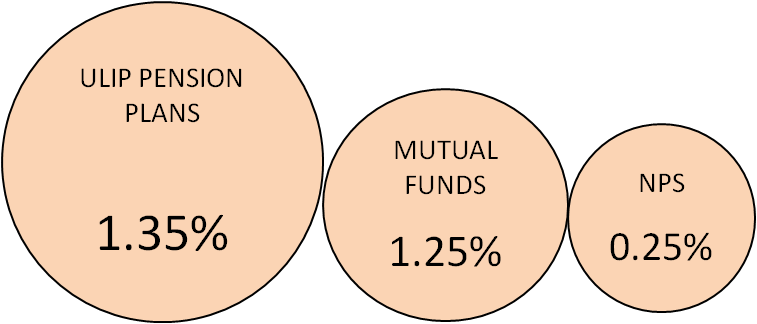
As discussed before the costs involved are minimal, only 0.25% of the investment is paid to the intermediary as fund management fee. Let us see how this cost is different from the costs of the other leading pension plans.
National Pension System (NPS)

Types of Funds in National Pension Scheme  

Class Of Fund Invested In Risk Average Return Since Launch (%)
E
Index based Stocks
Carry market risk like any large cap equity fund
3.79%
C
Bonds issued by State Govt, PSUs and Private Firms
Going by the quality of companies, risk would be low.
8.66%
G
Bonds issued by Central Govt.
Lacks default risk but volatility can't be avoided in long term bonds.
5.92%
Depending on how open the investor is to risk, the corpus can be divided among these three fund classes. Exposure to equity cannot be more than 50%. However if the allocation is not specified, the exposure to various classes, especially equity is decided on the basis of age. 
The above figure also tells us about the average performance of National Pension Scheme  funds in different classes.
The investment mix according to the age of the investor: 
Age of the Investor Percentage of Investment in Various Classes
Up to 35 Years 50% Equity and 50% Debt
40 Years 40% Equity and 60% Debt
45 Years 30% Equity and 70% Debt
50 Years 20% Equity and 80% Debt
55 Years 10% Equity and 90% Debt
 So with increasing age the investment corpus gets more inclined towards Debt

Pros and Cons of NPS 

Pros:

Additional Tax Benefit:

The Finance Bill 2011-12 permits tax deduction on contribution up to 10 per cent of basic salary and dearness allowance (DA) made by an employer towards the national pension scheme (NPS) account of an employee under Section 80CCE. This is over and above the Rs 1 lakh limit and is applicable if the contribution is done by the employer. This is the reason why corporate houses are accepting NPS happily.

There has been a hike in inquiries about NPS mainly because of the tax benefit under Section 80CCE.

Higher Fee to Intermediaries:

The fund management fee for non-government funds has been raised from 0.0009 per cent of assets under management to 0.25 per cent. The fee for government funds has been changed to 0.0102 per cent from April this year

PoPs are allowed to charge Rs 100 plus 0.25 per cent of the investment, as against a negligible fee of Rs 20 previously.

The change is promoting New Pension Scheme by offering incentives to distributors and fund managers. The fund management fee of 0.25 per cent is nothing when compared to other products. 
Cons:

Tax on Maturity Proceeds:

There is confusion about taxation at withdrawal. According to the present laws the funds would be taxed at withdrawal.

Under the current laws, around 60 per cent corpus on maturity can be withdrawn while at least 40 per cent has to be used to buy annuity. Presently, returns from annuity insurance plans are not tax-free.

The proposed Direct Taxes Code (DTC) plans to exempt NPS funds from tax at withdrawal. However, it is uncertain if the DTC would allow tax exemption on returns from annuity plans as well.

The tax at withdrawal stands in the way of making NPS the best pension scheme.

Mandatory Annuity:

Another lag is limitation on withdrawal from Tier-I account, the primary account for pension savings. On maturity also, one can withdraw only around 60 per cent funds; the rest has to be used to buy annuity, the returns from which are not tax exempted.

Even the annuity also has to be bought from one of the six PFRDA-approved insurers. Options to choose from in case of the number of annuity providers are anyway less with LIC commanding a 70 per cent market share.

Low on Equity:

NPS portfolios are restricted to have more than 50 per cent exposure to equity. It spells loss for people in their 20s or early 30s, as equity has shown to offer 12-15 per cent returns per year over long periods.

In comparison to traditional retirement schemes such as EPF and Public Provident Fund, which refrain from investing in stocks at all, NPS is the best as it is a lot more flexible in terms of equity exposure.

So, investors wanting higher equity exposure can go for equity mutual fund schemes such as large-cap funds and equity exchange-traded funds.
In Comparison to its competitors; EPS and Mutual Funds, NPS leads by
*Scoring better in performance (refer to the investment mix table) and costs
*But the 40% necessary investment in annuity after attaining the retirement age, 50% cap on equity exposure and taxation on annuity returns does make NPS a not so favorable option.
It is for the investor to decide as performance and costs are good characteristics of NPS that make the latter shine brighter than its expensive counterparts Such as Mutual Funds.

Latest News - National Pension Schemes (NPS)

Budget 2017 Brings Relief to the Salaried Individuals Investing in NPS

Delhi, India, Feb 01: With the release of Budget 2017, there is a relief for salaried individuals investing in National Pension Scheme (NPS) through their companies as they can now withdraw 25% of their handouts without paying any tax. The Government has initiated some amendments in NPS under which a part of withdrawal from National Pension Scheme is now Tax-free. This initiative taken by the finance minister Mr. Arun Jaitley has brought a major relief to the NPS subscribers.
The budget has eliminated the gap between individual tax-paying employees and self-employed persons in terms of income tax under section 80CCD. In order to grow the upper limit of contribution to NPS from 10% of gross total income of a salaried individual to 20%, the amendment of section 80CCD has been proposed.
According to the sources, the amendment will bring equality in tax treatment between the employee and self-employee or non-salaried individual. The measures taken by the government will come into action from April 1st 2018 and will be applicable to the assessment year of 2018-2019.

22 May 2017

Pradhan Mantri Vaya Vandana Yojana Plan No. 842

Pradhan Mantri Vaya Vandana Yojana Plan No. 842

Pradhan Mantri Vaya Vandana Yojana for citizens aged 60 years and above.


This LIC plan 842 will be available for sale upto 3rd May, 2018.

This is a Government subsidized pension Scheme which shall provide an assured return of 8% p.a. payable monthly (i.e. equivalent to 8.30% p.a.) on the pensioner surviving during the policy term of 10 years.

The Unique Identification Number (UIN) for "Pradhan Mantri Vaya Vandana Yojana" is 512G311V01. This number has to be quoted in all relevant documents furnished to the Policyholders and other users (public, distribution channels, etc.).

Benefits:

The benefits payable under this plan are as under:

Pension Payment :

On survival of the Pensioner during the policy term, Pension in arrears (at the end of each period as per mode chosen by the Pensioner) shall be payable.

Death Benefit:

On death of the Pensioner during the policy term, the Purchase Price shall be refunded to the nominee/legal heirs.

Maturity Benefit:

On survival of the pensioner to the end of the policy term, Purchase price and the final pension instalment shall be payable.

Eligibility Conditions and Restrictions:


Minimum Entry Age                : [60] years (completed)
Maximum Entry Age               : No limit
Policy Term                            : 10 Years
Minimum Pension                  : Rs. 1,000 per month / 3,000 per quarter / 6,000 per half year / 12,000 per year
Maximum Pension                 : Rs. 5,000 per month / 15,000 per quarter / 30,000 per half year / 60,000 per year

Ceiling of maximum pension is for a family as a whole i.e. total amount of pension under all
the policies allowed to a family under this plan shall not exceed the maximum pension limit.
The family for this purpose will comprise of pensioner, his/her spouse and dependants.

Mode of Pension Payment :

Mode of pension payment shall be monthly, quarterly, half-yearly or yearly.


The pension payment shall be through NEFT or Aadhaar Enabled Payment System.

The first instalment of pension shall be paid after 1 year, 6 months, 3 months, or 1 month from
the date of purchase of the same depending on the mode of pension payment i.e. yearly, half-
yearly, quarterly or monthly respectively.


Pension Rates:

The pension rates are not age specific and the rate of pension for Rs.1000/— purchase price for
different modes of pension payments are as below:

Yearly :                       Rs. 83.00 pa.
Half-yearly :                Rs. 81.30 pa.
Quarterly :                  Rs. 80.50 pa.
Monthly :                    Rs. 80.00 p.a.

The pension instalment shall be rounded off to the nearest rupee.


LIC Pradhan Mantri Vaya Vandana Yojana Plan No. 842 Details


Purchase Price:


The plan can be purchased by payment of a lump sum Purchase Price. The pensioner has an
option to choose either the amount of pension or the Purchase Price.

For offline sale of policies, the Purchase Price payable shall be accepted by cheques/drafts
payable on the Branch of the Bank which is member of the Local / CTS/ Speed Clearing Center.

The minimum and maximum Purchase Price under different modes of pension will be as under:

Mode of Pension Minimum Purchase Price Maximum Purchase Price


Yearly                                       Rs. 1,44,578/— Rs. 7,22,892/—
Half-yearly                                Rs. 1,47,601/— Rs. 7,38,007/—
Quarterly                                  Rs. 1,49,068/— Rs. 7,45,342/—
Monthly                                    Rs. 1,50,000/— Rs. 7,50,000/—

The purchase price shall be rounded off to the nearest rupee.

Rebates:

No rebate (including CEIS rebate) is available under this plan.

Taxes:


Statutory Taxes, if any, imposed on this Plan by the Government of India or any other
constitutional tax Authority of India shall be as per the Tax laws and the rate of tax as applicable
from time to time.

Surrender Value:


The scheme allows premature exit during the policy term under exceptional circumstances like
the Pensioner requiring money for the treatment of any critical/terminal illness of self or spouse.
The Surrender Value payable in such cases shall be 98% of Purchase Price.

Loan:


Loan facility is available after completion of 3 policy years. The maximum loan that can be
granted shall be 75% of the Purchase Price.

The rate of interest to be charged for loan amount would be determined from time to time by the
Corporation.

Loan interest will be recovered from pension amount payable under the policy. The Loan
interest will accrue as per the frequency of pension payment under the policy and it will be due
on the due date of pension. However, the loan outstanding shall be recovered from the claim
proceeds at the time of exit.


Suicide Clause: 

There shall be no exclusion on count of suicide and full Purchase Price shall be payable.


Free Look Period :

If a policyholder is not satisfied with the "Terms and Conditions” of the policy, he/she may return
the policy to the Corporation within 15 days (30 days if this policy is purchased online) from the
date of receipt of the policy.

The amount to be refunded within free look period shall be the Purchase Price deposited by the
policyholder after deducting the charges for Stamp duty and pension paid, if any.

Policy stamping :

Policy stamping charges will be at the rate of 20 paisa per thousand of Purchase Price under
this Plan.

Reinsurance:

No reinsurance is required for policies taken under this plan.


Assignments/Nominations

Assignment as per section 38 of the insurance Act, 1938 as amended from time to time shall be

allowed in favour of HO of india only, if pensioner opts for loan under the policy.

Nomination by the pensioner is required as per Section 39 of the insurance Act, 1938, as
amended from time to time.

The notice of nomination or change of nomination should be submitted for registration to the
office of the Corporation, where the policy is serviced. In registering nomination the Corporation
does not accept any responsibility or express any opinion as to its validity or legal effect.


Pradhan Mantri Vaya Vandana Yojana - 842- Proposal Form


Normal requirements for claim:


All the claim payments under this plan shall be paid through NEFT/ Aadhaar Enabled Payment
System. Other requirements are as under:

For benefit payable on death of the Pensioner:


The normal documents which the claimant shall submit while lodging the claim in case of death
of the Pensioner shall be claim forms, as prescribed by the Corporation, accompanied with
original policy document, proof of title, proof of death, to the satisfaction of the Corporation. if

the age is not admitted under the policy, the proof of age of the Pensioner shall also be
submitted.

For pension payments:


The Pensioner shall submit the Life Certificate in the proforma of the Corporation or online
“Jeevan Pramaan” as enabled by Corporation in this regard at the time intervals as prescribed
from time to time. The pension payments shall be released only on receipt of the Life Certificate.

For benefit payable on Surrender:

The Pensioner shall submit the discharge form along with the original policy document, proof of
medical treatment of self/spouse and proof of age, if the age is not admitted earlier.


For benefit payable on Maturity:

The Pensioner shall submit the discharge form along with the original policy document and
proof of age, if the age is not admitted earlier.

LIC'S NEW PLAN AADHAR STAMBH

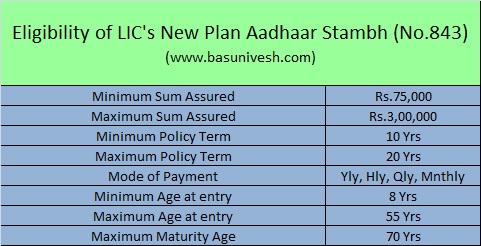
LIC’s New Plan Aadhaar Stambh (No.843) Eligibility

LIC's New Plan Aadhaar Stambh (No.843) Eligibility
You notice one thing that that maximum sum assured is ONLY Rs.3,00,000.

LIC’s New Plan Aadhaar Stambh (No.843) Benefits

The benefits of LIC’s New Plan Aadhaar Stambh (No.843) are explained as below.

LIC’s New Plan Aadhaar Stambh (No.843) Death Benefits

# If death occurs within first 5 years
Sum Assured on Death will be payable to the nominee. Sum Assured on Death is nothing but 110% of Basic Sum Assured. Basic Sum Assured means the sum assured you opted while buying this plan.
# If death occurs after 5th year but before maturity
Sum Assured on Death+Loyalty Addition will be payable to the nominee.
The death benefit will not be less than the 105% of all the premium paid in the policy as on date of the death of the policyholder.
Do remember that the premium paid means it will not include any taxes, extra amount charged due to underwriting decision and rider premium if any.

LIC’s New Plan Aadhaar Stambh (No.843) Maturity Benefits

Sum Assured at Maturity+Loyalty Addition. Here, Sum Assured at Maturity is equal to Basic Sum Assured

LIC’s New Plan Aadhaar Stambh (No.843) Auto Cover Benefits

When you fail to pay the insurance premium within due date, then the policy will be converted as Paid Up policy. Auto Cover Period is a period from the due date of the first unpaid period (FUP). This also includes grace period.
During this Auto Cover Period, the policyholder will have the same life risk cover which he opted in the plan even though he failed to pay the premium within due dates.
The Auto Cover Period benefit available in this plan is as below.
# If at least 3 yrs but less than 5 Yrs paid but any subsequent premium is not duly paid
Auto Cover period of 6 months from the due date of the first unpaid premium will be available.
If at least 5 Yrs premium have been paid but any subsequent premium is not paid
Auto Cover period of 2 Yrs from the due date of the first unpaid premium will be available.

LIC’s New Plan Aadhaar Stambh (No.843) other features

# You can avail loan facility after 3 years from the start of the policy.
# You can revive the lapsed policy within the 2 years of first unpaid premium.
# You can opt for LIC’s Accidental Rider Benefit with this plan.

LIC’s New Plan Aadhaar Stambh (No.843) Review

As of now I have limited source of information. However, if one go by the features and benefits of this product, it is one more pathetic product from LIC. Nothing is new in this plan except they used Aadhaar as a compulsory to buy this plan and also this plan is meant only for males.
Rest of the features looks like typical endowment plan with nothing much to expect than 5% to 6% returns. Also, the biggest drawback of this plan is restricting the maximum sum assured at Rs.3,00,000. However, for many of us such death claim amount may last for 1-2 years to survive. Then how can we buy such low insured product as if the life risk product which benefits our financial dependents? Strange but logically meant to encash Aadhaar based news and to trap rural population.

LIC'S NEW PLAN AADHAR SHILA

LIC’s New Plan Aadhaar Shila (No.844) is the Non-Linked (Non-ULIP), with profits, regular premium endowment assurance plan. This means it is not linked to stock market and we may call it as traditional endowment type of plan.
This is the special plan for females who have Aadhaar Card. There will not be any medical examination in this plan.

LIC’s New Plan Aadhaar Shila (No.844) Eligibility

Eligibility of LIC's New Plan Aadhaar Shila (No.844)
You notice one thing that that maximum sum assured is ONLY Rs.3,00,000.

LIC’s New Plan Aadhaar Shila (No.844) Benefits

The benefits of LIC’s New Plan Aadhaar Shila (No.844) are explained as below.

LIC’s New Plan Aadhaar Shila (No.844) Death Benefits

# If death occurs within first 5 years
Sum Assured on Death will be payable to the nominee. Sum Assured on Death is nothing but 110% of Basic Sum Assured. Basic Sum Assured means the sum assured you opted while buying this plan.
# If death occurs after 5th year but before maturity
Sum Assured on Death+Loyalty Addition will be payable to the nominee.
The death benefit will not be less than the 105% of all the premium paid in the policy as on date of the death of the policyholder.
Do remember that the premium paid means it will not include any taxes, extra amount charged due to underwriting decision and rider premium if any.

LIC’s New Plan Aadhaar Shila (No.844) Maturity Benefits

Sum Assured at Maturity+Loyalty Addition. Here, Sum Assured at Maturity is equal to Basic Sum Assured

LIC’s New Plan Aadhaar Shila (No.844) Auto Cover Benefits

When you fail to pay the insurance premium within due date, then the policy will be converted as Paid Up policy. Auto Cover Period is a period from the due date of the first unpaid period (FUP). This also includes grace period.
During this Auto Cover Period, the policyholder will have the same life risk cover which he opted in the plan even though he failed to pay the premium within due dates.
The Auto Cover Period benefit available in this plan is as below.
# If at least 3 yrs but less than 5 Yrs paid but any subsequent premium is not duly paid
Auto Cover period of 6 months from the due date of the first unpaid premium will be available.
If at least 5 Yrs premium have been paid but any subsequent premium is not paid
Auto Cover period of 2 Yrs from the due date of the first unpaid premium will be available.

LIC’s New Plan Aadhaar Shila (No.844) other features

# You can avail loan facility after 3 years from the start of the policy.
# You can revive the lapsed policy within the 2 years of first unpaid premium.
# You can opt for LIC’s Accidental Rider Benefit with this plan.

LIC’s New Plan Aadhaar Shila (No.844) Review

As of now I have limited source of information. However, if one go by the features and benefits of this product, it is one more pathetic product from LIC. Nothing is new in this plan except they used Aadhaar as a compulsory to buy this plan and also this plan is meant only for females.
Rest of the features looks like typical endowment plan with nothing much to expect than 5% to 6% returns. Also, the biggest drawback of this plan is restricting the maximum sum assured at Rs.3,00,000. However, for many of us such death claim amount may last for 1-2 years to survive. Then how can we buy such low insured product as if the life risk product which benefits our financial dependents? Strange but logically meant to encash Aadhaar based news and to trap rural population.